The boss instructs a team. The leader leads one. The introvert works alone and finds it hard going. Then the introvert gets AI and outruns all of them, and that is a match of temperament rather than an accident of tooling.
In short
- The first three panels all depend on other people. The boss and the leader are effective only while they have a team. Take the people away and neither works.
- The fourth panel does not hand the introvert a team. It hands them an engine, and puts them in the cab driving it.
- AI rewards the traits that make somebody an introvert. A text medium, infinite patience, no social cost, and a payoff for long uninterrupted focus.
- They were already doing the expensive part. Self-directed learning and deep understanding are exactly what make AI output good.
- If seniority still means headcount directed, you are measuring the thing the fourth panel just made optional.
There is a meme that goes around every few months. Four panels, stick figures, and a sharper observation about work than most things written on the subject.
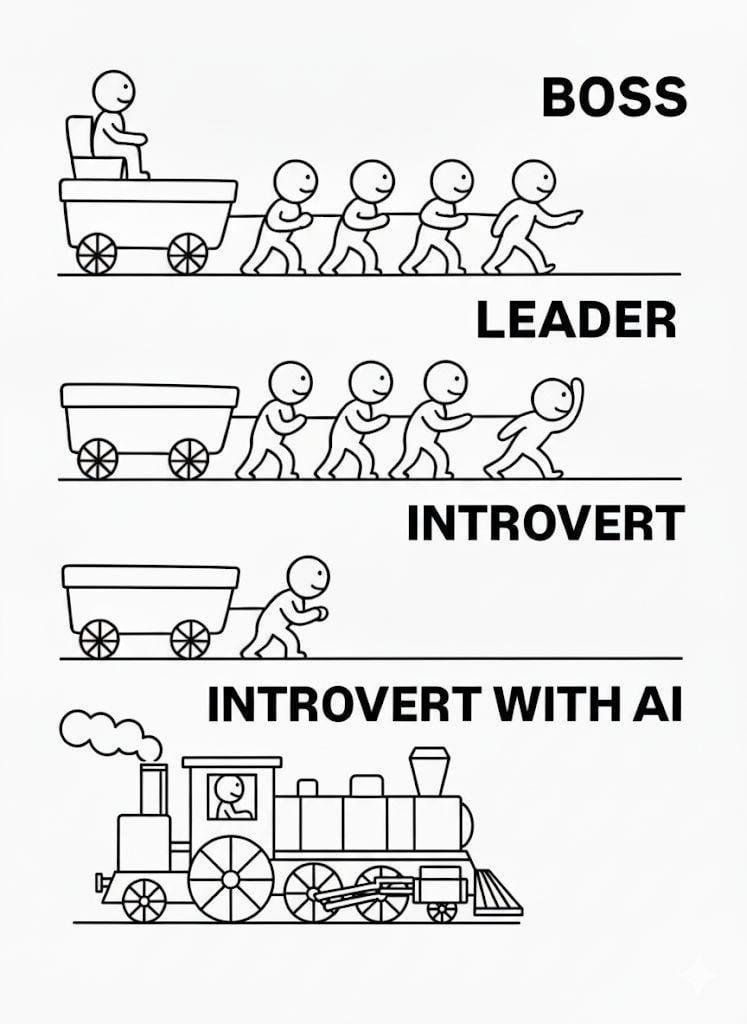
The boss sits in the cart and instructs. Four people pull. The leader is down with the team, pulling alongside them, one arm raised, setting direction from inside the effort rather than above it. The introvert pulls the cart alone, and it is visibly hard going. And then the introvert with AI is a full steam locomotive.
Most people share it for the joke. It is worth taking seriously, because it captures something true about where capability now comes from, and it gets one thing right that almost all commentary on AI gets wrong.
Three ways to move a load, and two of them need a team
Look at the first three panels together. The boss moves the load by instructing people. The leader moves it by leading them. The introvert moves it alone and struggles, which is honest, because that is exactly what happens.
What the first two have in common is that their capability flows through other humans. Both are effective, and both are effective because they have a team. Take the people away and neither panel works at all. Their output is a function of how many people they can direct and how well they can direct them.
The introvert is not less able in that third panel. They are less leveraged. Same intelligence, same ideas, no multiplier. Anyone who has watched a thoughtful colleague produce excellent work slowly, while a better-networked one produces adequate work quickly, knows precisely what that panel is drawing.
For most of working life, that was simply the deal. Capability scaled with the number of people you could organise, which quietly rewarded one temperament and quietly penalised another.
The fourth panel does not hand them a team
Here is what makes the meme good. The introvert does not solve the problem by becoming more sociable, hiring staff, or learning to delegate. The joke would be far weaker if the fourth panel showed the introvert leading a team. It would also be the usual advice, and the usual advice has never worked especially well for people who do their best thinking alone.
Instead they get an engine.
And notice, because very few people do, that there is somebody in the cab. Look at the small window on the side of the locomotive. The introvert is not standing beside the machine admiring it, and is not being carried along by it. They are sitting in the driving position, working the controls.
The meme is not saying the machine replaced them. It is saying they are now driving something considerably larger than themselves, with nobody else in the picture.
The result is not that the introvert catches up with the boss and the leader. They go past them. A locomotive is not four people pulling a cart slightly faster. It is a different order of capability, available to one person, with nobody to convene.
Why AI suits the introvert specifically
This is the part I find genuinely interesting, and it is not a coincidence of the drawing. AI rewards almost exactly the traits that make somebody an introvert in the first place.
- It is a text medium. A great many introverts think best in writing. The exchange that would be draining in a meeting room is comfortable in a document, at your own pace.
- It is infinitely patient and carries no social cost. You can ask the same question fifteen different ways, and go back over ground you feel you should already know, with nobody forming a view about you while you do it.
- It rewards long, uninterrupted focus, which is the working mode introverts tend to prefer and defend.
- It removes the expensive parts. Convening people, chasing progress, negotiating priorities, and getting five diaries into the same hour.
For anyone who has ever stayed quiet rather than ask the obvious question, that second point is not a small unlock. It is an enormous one. What is left is the part they were always good at: sitting with a problem, following an idea until it works, and learning something properly rather than sufficiently.
They were already doing the hard part
There is a version of this argument that undersells what is happening, which is to say that AI made the introvert productive. True, but thin. The stronger claim is that introverts were frequently already doing the things that make AI genuinely useful, and doing them with no leverage whatsoever.
They tend to drive their own learning rather than waiting to be trained. They hold concepts and ideas rather than only tasks. They will go and properly understand a subject because it is interesting, not because a project demanded it this quarter. In a conventional structure a lot of that goes unrewarded, because organisations mostly measure visible contribution, and quiet depth is not visible.
Give that person an engine and the picture changes very quickly. Deep understanding is exactly what makes AI output good, because knowing what you actually want is most of the work. Somebody who has quietly built a real model of a subject can direct a capable tool with precision, recognise when the answer is wrong, and push it somewhere better. Somebody who has not will get plausible-looking output and no way to judge it.
What actually changes in the work
It is worth being concrete about what the day looks like afterwards, because it is not the old job done faster. The proportions invert.
Producing used to be most of the work, with deciding as a thin slice at either end. Now producing is minutes and deciding is very nearly all of it: what to make, whether the thing that came back is right, what to throw away, and when to stop.
Reading becomes more valuable than writing. The constraint is no longer how quickly you can get words or code out. It is how quickly and accurately you can judge what you are looking at. That is a different muscle, and depth is the only thing that builds it.
Time also moves to the question. A well-formed problem statement is worth far more than it used to be, because it is the part the machine cannot supply. An hour spent getting the question right now pays back in a way that an hour spent polishing the draft no longer does.
And the failure mode changes. The old risk was not finishing. The new risk is finishing something confidently wrong, quickly, with nothing obvious to signal that anything is amiss. For the introvert this is mostly good news, because the things that got harder are the things they already preferred doing.
Equal, then past
It is worth being specific about how the surpassing actually happens, because it is not simply raw speed. Coordination has a cost, and it is larger than most organisations will admit.
The interesting part of that tax is not the time. It is the leakage. Every handover is a chance for intent to degrade a little: the person who understood why is not always the person doing the work, and what arrives at the other end is a reasonable interpretation of an instruction rather than the thing that was actually wanted. Most delivery problems I have seen are some version of that, and they are almost never visible in a status report.
The introvert with an engine pays none of it. The whole problem stays in one head. There is no dilution of intent between the person who understood the goal and the person doing the work, because they are the same person. Nothing is lost in translation, because nothing is translated.
That is how the fourth panel gets past the first two. Not by out-pulling them, but by not paying the toll they are both paying.
What the driver still has to bring
One caveat, and only one, because this is not a warning piece. The locomotive amplifies whatever the driver brings to it. Expertise in, leverage out. Surface familiarity in, a faster and considerably more confident crash out. The engine has no view on whether the route is correct.
Which is to say the advantage described here belongs to the introvert who genuinely understands their subject, not to anybody who happens to own the same subscription. The meme, to its credit, put a person in the cab rather than in the passenger seat. Driving is still a skill, and the machine does not supply it.
Where the team still wins
It would be a poor argument if it did not say where it stops. The engine helps enormously when the constraint is production. It does very little when the constraint is something else.
- When the bottleneck is access or agreement. If the hard part is getting six stakeholders to say yes, or getting into the building, no amount of capability upstream of that changes the date.
- When the work is genuinely parallel. Some things are simply large. A locomotive is fast on one track. It is no use at all on four at once.
- When presence is the product. Facilitation, negotiation, difficult conversations, anything where being in the room is the job rather than a means to it.
- When sign-off is regulated. Producing the evidence faster does not move the pace of a regulator, an auditor or a safety case.
And one that matters more than the rest. One person is a single point of failure. A team absorbs illness, holiday and resignation. An individual with an engine does not. If your most productive contributor has quietly become a department of one, you have concentrated risk at the same time as capability, and that is better named out loud now than discovered in August.
None of that reverses the argument. It bounds it. The introvert with an engine outruns the team on work where production was the constraint, which is a very large share of knowledge work, and does not on work where it never was.
If you recognise yourself in the third panel
A few things are worth saying to the person who has spent a career pulling the cart alone. The advantage is real, but it is not automatic, and it does not arrive with the subscription. It comes from depth, and depth is the one thing that still has to be earned the slow way.
- Go deeper rather than wider. Breadth is cheap now. Depth decides whether the output is any good.
- Protect the long sessions. Three uninterrupted hours are worth considerably more than a day chopped into meetings, and that gap has widened.
- Finish things end to end. Fragments are easy to generate and prove very little.
- Then let somebody see it. Capability nobody knows about still does not get used.
That last one is the genuine weakness of the temperament, and the engine does not fix it. You do not have to become a different person to solve it. You only have to occasionally tell somebody what you built, which is a much smaller ask than becoming an extrovert.
What this means if you run a team
There is a practical consequence here, and it is uncomfortable for a lot of organisations. You almost certainly have people whose output has changed dramatically in the last two years and whose position in the structure has not moved at all. They are quiet. They do not present especially well. They have never asked for a team, and under the old arithmetic that capped what they could contribute, regardless of how good they were.
That cap has gone, and most organisation charts have not noticed. If your definition of seniority still rests on how many people somebody directs, you are measuring the precise thing the fourth panel just made optional.
- Look at output rather than presence. The most productive person in a modern team is often the least visible one.
- Stop treating a team as the only reward. If the only route to seniority runs through line management, you will keep promoting your best individual contributors into a job that suits them badly.
- Ask the quiet ones what they have built. The answer is frequently surprising, and frequently something nobody asked them to do.
The quiet one has an engine now
For a very long time, capability scaled with the number of people you could organise. That favoured a particular temperament, and it left a lot of capable people pulling a cart on their own and wondering why the work was so heavy.
That is no longer the only route. One person who thinks deeply, learns independently and works comfortably alone can now move a load that used to require a team, and can move it further and faster than the team would have.
The boss still instructs. The leader still leads. Both remain valuable, and neither is going anywhere. But the quiet one in the corner has an engine now, and there is somebody in the cab. If you run a team, the first step is simply to go and find out what they have been building.

DCCO is an independent technology consultancy working across the UK and Europe. Founded in 2009, it covers AI adoption, rapid software development, and vendor-neutral advice on digital signage, DOOH, and IT and AV transformation.