The version everyone posts stops at the panel that flatters them. The two that follow show a leader whose whole team got their own aircraft, and a boss whose team got machines but stayed wired to his. Same technology, opposite outcome.
In short
- The meme has six panels, not four. Most people stop sharing at the one that flatters them.
- Count the pilots in the leader's panel. Every aircraft has somebody flying it. The capability went out to the edge.
- Then look at the cables in the boss's panel. His team got machines too, but every pod is wired back to the centre.
- AI does not change your structure. It hardens it. Clear accountability gets faster. Vague accountability produces more unowned work, sooner.
- Both look identical on the metrics you already track. The difference only shows up when somebody is challenged, or goes on holiday.
In the previous piece I wrote about the fourth panel of a meme: the introvert who stops pulling a cart and ends up driving a locomotive. The empowerment is real, and the detail that makes the drawing good is that there is somebody sitting in the cab.
But that meme has six panels, not four. Most people never see the last two, because most people stop sharing at the panel that flatters them.
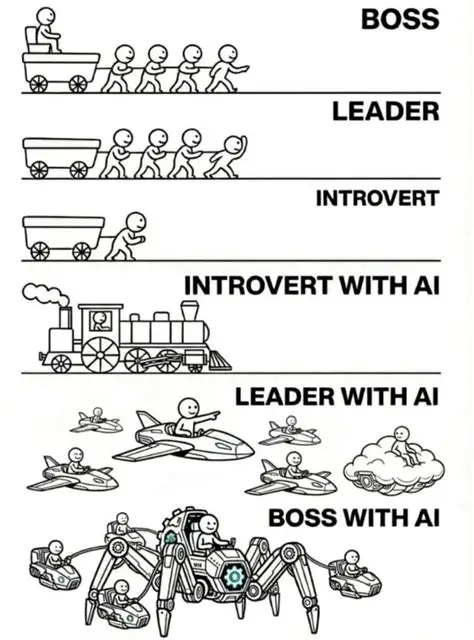
Panel five, leader with AI: a formation of aircraft. Panel six, boss with AI: an enormous walking machine with the boss at the centre of it.
At a glance they look like the same joke told twice, which is presumably why they get cropped. Look properly and they are the most interesting part of the whole thing, because they are not really about technology at all.
What each of them actually did with it
Start with the leader's panel, and count the pilots.
There is a large aircraft at the front with the leader in it, pointing the way. And then there are four more aircraft, and every single one of them has somebody flying it. The team did not disappear when the technology arrived. Each member of it got their own machine.
Now the boss's panel. The boss is in the centre, in the biggest machine on the page. Around him are four smaller pods, and each of those has a person in it too. So far, the same story.
Except look at what runs between them. Every pod is cabled back to the boss's machine.
Both of them gave their team the same capability. One let it go to the edge. The other kept hold of the wire.
Same technology, opposite outcome
Put the panels side by side and the pattern is hard to miss.
Before AI, the two structures looked much alike. A load, a team, and somebody either riding on it or pulling at the front of it. The difference between a boss and a leader in those early panels is real but modest: one is in the cart, the other is in the traces.
Afterwards they are not the same shape at all.
The leader's team ends up distributed. Five machines, five operators, no cables. The leader still leads, and there is still a direction, but the capability now sits at the edge, with the people doing the work.
The boss's team ends up centralised, and more centralised than it was. Everyone is more capable, and everyone is still wired to one seat. The dependency did not go away. It got industrialised: more capital, more complexity, and more people's work now riding on the same single point of failure that was always there.
AI handed the boss a bigger cart, and everyone called it transformation.
AI does not change your structure. It hardens it.
That is the general claim, and I think it is the most useful thing the meme has to say.
Technology deployed onto an organisation does not reform that organisation. It makes it more of whatever it already was. I have spent a long time putting operational platforms into businesses, and the pattern is consistent enough to plan around.
- If accountability is clear, better tools make accountable people faster.
- If accountability is vague, better tools produce more work that nobody owns, sooner.
- If your processes are genuinely understood, automation makes them cheaper.
- If nobody can explain them end to end, automation executes the misunderstanding at scale, confidently, with a clean audit trail.
- If your culture trusts people at the edge, capability at the edge compounds.
- If it does not, capability at the edge gets routed back to the centre for approval. The cables in panel six are what that looks like when somebody draws it.
None of that is a criticism of the technology. It is a description of what amplifiers do.
What the cables actually cost
It is worth being specific here, because "centralised is bad" is a slogan rather than an argument, and plenty of organisations are centralised for perfectly good reasons.
The cost is not the structure itself. It is that the structure did not move while the capability did.
Each pod in panel six can now do considerably more than the person in panel one could. What has not changed is where a decision gets made. The work speeds up and the decision rate does not, so the queue at the centre grows. You have paid for capability and bought yourself a bottleneck with better throughput on either side of it.
There is a second cost, and it is easier to miss. When every decision routes through one person, that person is the only one practising judgement. The four in the pods are executing. Give it two years and they will be extremely good at executing and no better at deciding, and the organisation will have quietly lost the ability to promote anybody.
The leader's formation has the opposite property. Four people are making calls, being wrong occasionally, and finding out what a good decision feels like. That is not a side effect. Over any reasonable horizon it is the more valuable of the two outputs.
Why the leader's panel is harder than it looks
It is worth saying plainly that the fifth panel is not the easy option. It is the one that asks something of the person in charge.
Handing capability to the edge means accepting that four people will now do things you would have done differently. Some of those will be worse than your version. A few will be better, which is its own adjustment. The leader in that panel is pointing, not steering each aircraft individually, and that is a real loss of control rather than a rhetorical one.
The boss's panel is, in a sense, the more natural response. Everyone suddenly got more powerful, the stakes went up, so hold on tighter. It feels like diligence. It looks like responsibility. And it is precisely the wrong instinct.
This is how organisations are actually adopting AI
Most adoption is not happening in the introvert's panel at all. It is being driven from the fifth and the sixth, deployed top down across teams on the strength of a demonstration, a vendor promise, or a competitor's announcement.
The individual with AI usually earned the capability. They learned the tool because they were curious, or because they had a problem nobody else was solving, and their facility with it is grounded in use. Organisational deployment tends to skip that step entirely.
The question that gets asked is how much faster can we go. The question that does not get asked is which of these two panels we are building.
The metrics will look excellent
There is a reason this goes unnoticed for longer than it should.
The things that improve are the things already being measured. Output volume, cycle time, tickets closed, documents produced. Both panels improve on all of them, immediately and visibly, and both look like a successful programme at the first quarterly review.
The things that separate them are the things nobody has an instrument for. Whether the person who produced the work could defend it. Whether anyone genuinely owns the outcome. Whether judgement is being practised anywhere other than the centre. Whether the queue is getting longer.
I spent twenty years building monitoring systems, and this is the oldest trap in that discipline. You measure what is easy to measure, the numbers look healthy, and the thing that eventually fails was never on the dashboard at all.
The early months of a well-structured deployment and a badly structured one look identical. The difference shows up when somebody is challenged and cannot explain their own work, or when the person at the centre takes a week off and everything stops.
How to take the cables off
If you look at your own organisation and recognise panel six, the answer is not a reorganisation. It is a series of small, specific transfers of authority, and they are cheaper than they sound.
- Name the decisions, not the roles. Most approval culture is not written down anywhere. Nobody decided that this needs signing off, it simply always has been. Write the list down and half of it will not survive being read aloud.
- Set thresholds instead of gates. "Anything under this, decide and tell me afterwards" removes a queue without removing oversight, and it is reversible if it goes badly.
- Separate the reversible from the irreversible. Decisions that are cheap to undo do not need the same ceremony as decisions that are not, and most organisations apply one process to both.
- Let the first few go imperfectly. If every delegated decision is quietly corrected afterwards, you have not delegated anything, you have added a step.
None of that requires new technology, which is the point. The capability is already in the building. What is missing is permission for it to be used more than one place at a time.
Which panel are you building?
Four questions. None are technical, and all of them can be answered by walking around and asking.
- Who is allowed to decide without asking? If the honest answer is nobody, you are drawing cables whether you meant to or not.
- Where does work wait? Not where it is done. Where it sits. Queues form in front of the constraint, and the constraint is almost never the tooling.
- Who is practising judgement? If one person makes all the real calls, one person is getting better at making them.
- What happens when the centre is unavailable? A week of annual leave is a cheap and honest test of a structure.
The panels are a mirror
Strip away the joke and the last two panels are not predictions. They are a mirror.
The technology in panel five and panel six is identical. The outcome is not, and nothing in the tooling explains the difference. What explains it is the structure that was already there on the day it arrived, and the instinct of the person at the centre when everybody around them suddenly became more capable.
The boss's machine is bigger, more expensive and far more impressive to look at. It is also the same organisation it always was, with better equipment and shorter leashes.
If you are rolling this out across a team, the useful work is not choosing the tools. It is deciding, deliberately and in advance, which of those two pictures you are building. You will end up with one of them either way.

DCCO is an independent technology consultancy working across the UK and Europe. Founded in 2009, it covers AI adoption, rapid software development, and vendor-neutral advice on digital signage, DOOH, and IT and AV transformation.